Year
1865-1870
Medium
Oil on Canvas
Dimensions
138.5 × 84.5 cm
Region
France
Listen
click play to listen
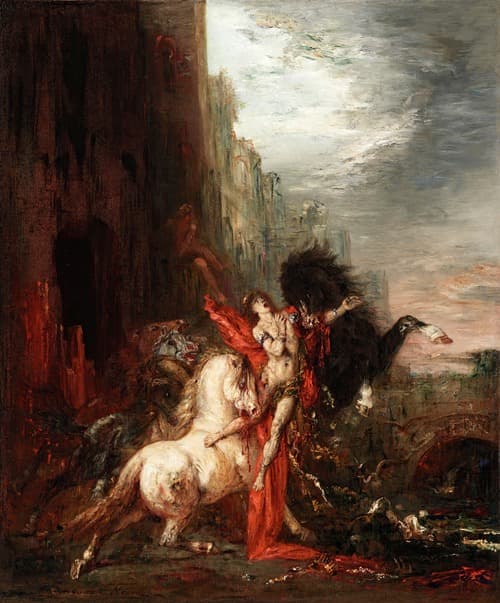
Diomedes Devoured by His Horses (Diomède dévoré par ses chevaux, 1865–1866, oil on canvas, 138.5 × 84.5 cm, Musée des Beaux-Arts, Rouen) is a mythological painting by Gustave Moreau, exhibited at the Salon of 1866 as the follow-up to the Salon triumph of Oedipus and the Sphinx (1864). The painting depicts the culminating moment of the eighth Labour of Hercules: the Thracian king Diomedes — who had trained his horses to devour human flesh — is destroyed by those same horses, which his conqueror Hercules has turned against him. Moreau's compositional treatment is formally radical: rather than placing Hercules at the center of heroic action, the painter reduces him to a tiny, passive figure watching from an elevated position on a wall while the equine violence is enacted in the foreground without his direct participation. The drama of the foreground — white and black horses tearing at Diomedes's pallid body, the blood-red cloak streaming from his helpless figure — is organized through extreme chromatic contrasts into something approaching pictorial order, while the classical architectural ruins provide a theatrical framework of legendary antiquity. A second version of the painting is held in the Detroit Institute of Arts, and related studies and watercolours document Moreau's extensive preparation. Moreau himself was not entirely satisfied with the Rouen painting, expressing in a letter to its curator the wish that he could have sent "a larger and more accomplished picture." Formed by the tradition of Géricault, Delacroix, Chassériau, and the Italian Renaissance masters he had studied in Rome and Florence, the painting is simultaneously a virtuosic exercise in equine painting, a meditation on justice and retribution in the classical tradition, and a characteristically Moreauian reflection on the relationship between the passive observer and the violent spectacle set in motion on his behalf — a quality that the Musée des Beaux-Arts, Rouen, has identified as the painting's most distinctively personal and enduring contribution.