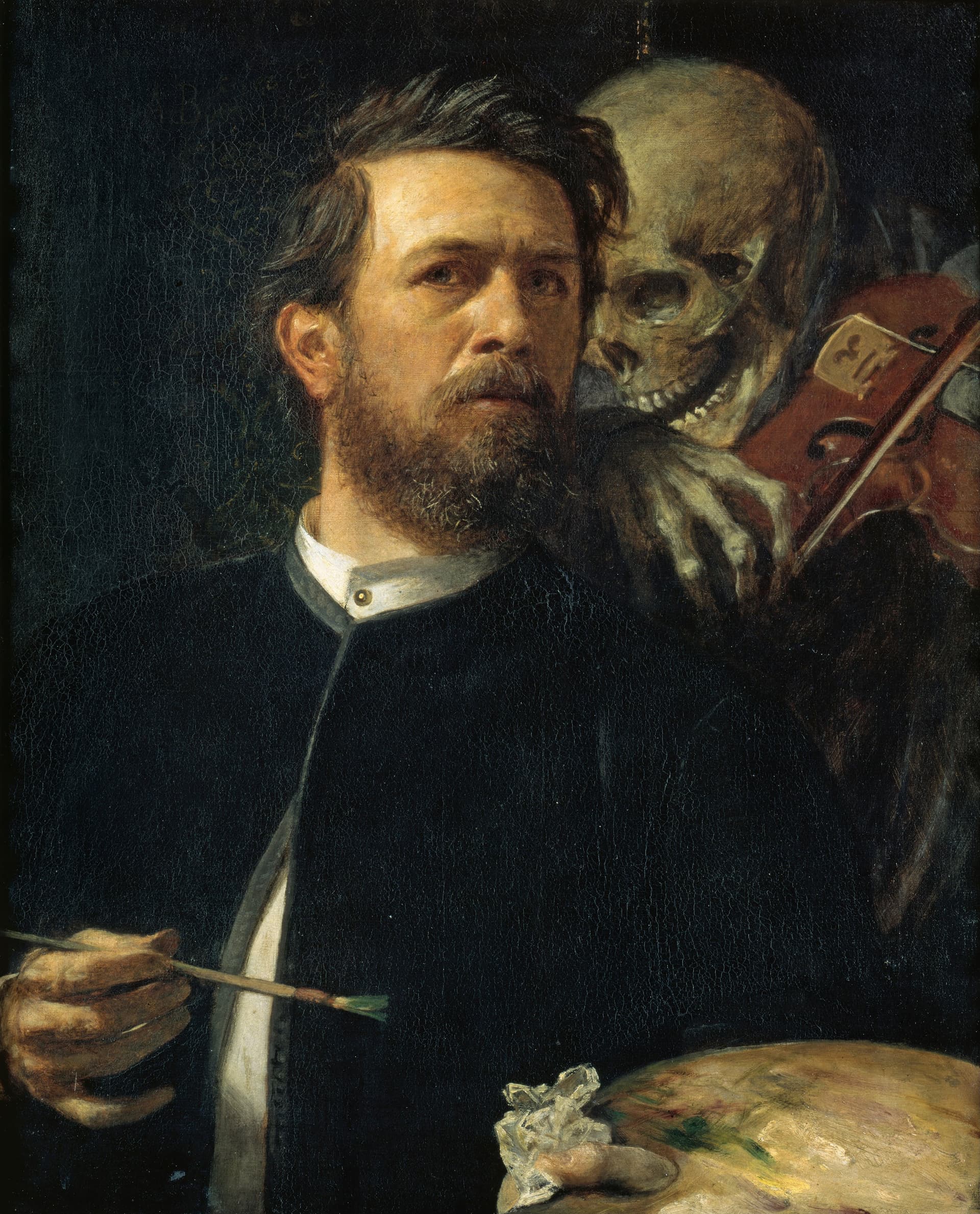
by Arnold Böcklin
Read BiographyYear
1872
Medium
Oil on canvas
Dimensions
75 cm × 61 cm
Region
Germany
Listen
click play to listen
Self-Portrait with Death Playing the Fiddle (Selbstbildnis mit fiedelndem Tod, 1872, oil on canvas, 75 × 61 cm, Alte Nationalgalerie, Berlin) is the most celebrated self-portrait by the Swiss Symbolist painter Arnold Böcklin, first exhibited at the Kunstverein München in 1872 and now recognized as one of the defining images of nineteenth-century European art. The painting depicts a bearded Böcklin, palette and brush in hand but momentarily paused, listening with absorbed attention to the skeletal figure of Death that presses close to his right ear, playing a single-stringed fiddle — the only string remaining of what was presumably once a full instrument — with an eagerness that the skull's fixed grin amplifies into something between a grin and a leer. According to a biographical anecdote recorded in the painting's reception history, the Death figure was added only after a friend asked Böcklin what he appeared to be listening to, based on the far-off expression in his eyes; the Alte Nationalgalerie's scholarly commentary neither confirms nor entirely dismisses this story. The painting draws on the danse macabre tradition — specifically the misattributed Holbein portrait of Sir Bryan Tuke in the Alte Pinakothek — and on Holbein's own woodcut Dance of Death series, transforming these precedents through the specific compositional detail of the fiddle's single remaining string (the lowest G string, the most resonant and most final), which Böcklin used to suggest that his time — and the music — was nearly over. The image anticipates Böcklin's subsequent career-long preoccupation with mortality, most famously in the Isle of the Dead series (1880–1886), and influenced the generation of Symbolist and Surrealist painters that followed him, from Giorgio de Chirico to Max Ernst. In the twenty-first century, it has become one of the most widely reproduced and most digitally circulated nineteenth-century paintings, a testament to the enduring power of its combination of dark humor, formal clarity, and genuinely disturbing proximity between the artist and his death.