Year
circa 1891
Medium
Oil on Canvas
Dimensions
50 cm x 45.5 cm
Region
Listen
click play to listen
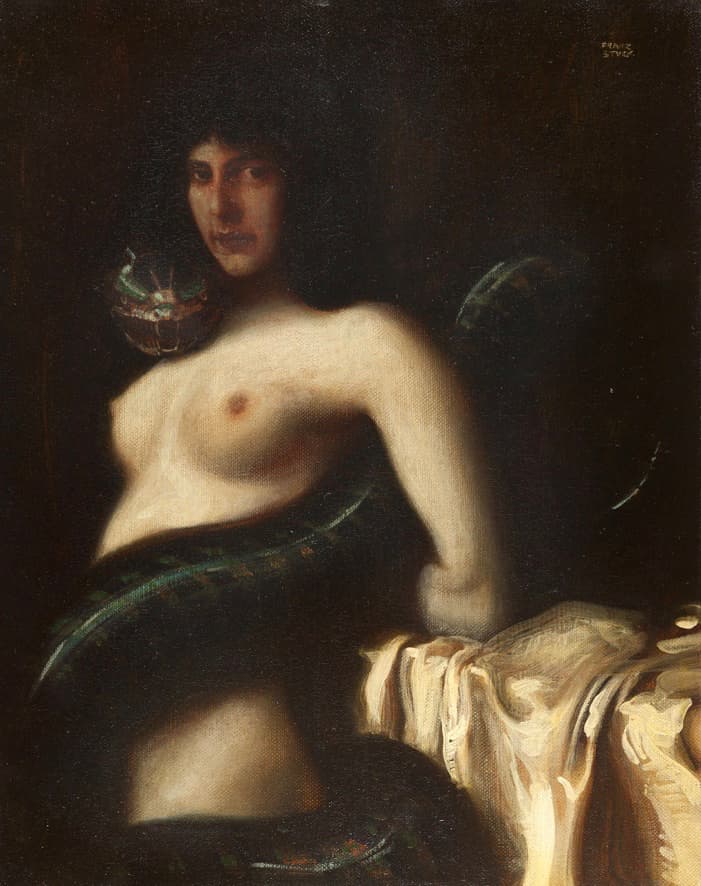
Sinnlichkeit (Sensuality, c. 1891, oil on canvas, private collection) is the founding work of Franz von Stuck's most celebrated compositional series — the image of a nude female figure entwined with a large serpent that he first conceived in 1889 and which reached its definitive public statement in Die Sünde (The Sin, 1893, Neue Pinakothek, Munich). Depicting a nude woman in deliberate, empowered complicity with the serpent she holds — their bodies entwined in a relationship of mutual authority rather than constraint or submission — the painting deploys the iconographic tradition of Eve and the Serpent in the Garden of Eden to produce an image that completely reverses the traditional moral valence of that tradition: in place of the shamed, grief-stricken sinner of Masaccio's Expulsion, Stuck gives us a figure who is unrepentant, self-possessed, and confrontational, her direct gaze demanding the viewer's acknowledgment on her own terms. Produced when Stuck was twenty-eight, in the immediate run-up to the co-founding of the Munich Secession (1892) and the sensational debut of Die Sünde (1893), Sinnlichkeit represents the private laboratory of compositional and thematic exploration from which the most publicly consequential image of his career emerged. The 1891 etching version — catalogued in the Danzker and Hardtwig catalogue raisonné as no. 47 and held in the Fine Arts Museums of San Francisco (Gift of John Gutmann, Acc. 1991.1.207) — provides the most widely accessible institutional record of the composition. Together, Sinnlichkeit and Die Sünde constitute the central achievement of Stuck's career and one of the most culturally resonant images in the history of German Symbolism.