Year
1876-1877
Medium
Watercolour and gouache with highlights on paper
Dimensions
106 × 72.2 cm
Region
France
Listen
click play to listen
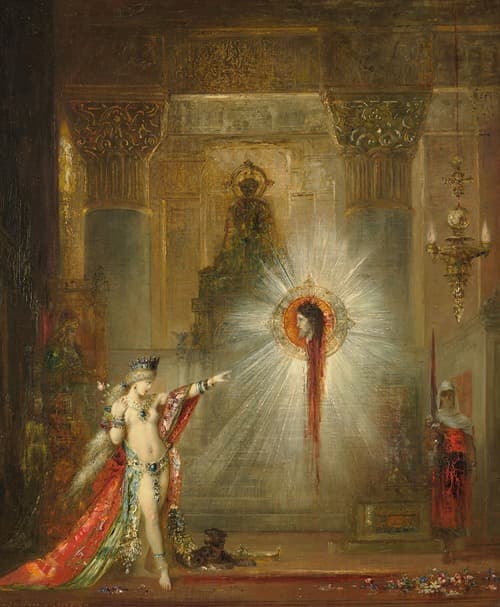
The Apparition (L'Apparition, 1874–1876, watercolour and gouache with highlights on paper, 106 × 72.2 cm, Musée d'Orsay, Paris) is the masterwork of Gustave Moreau's most celebrated period and the single most culturally consequential painting in the history of French Symbolism. Exhibited at the Salon of 1876 alongside its oil companion Salome Dancing before Herod, the watercolour depicts an unprecedented transformation of the biblical Salome narrative: rather than showing the dancer receiving the executed Baptist's head on a platter, Moreau depicts the severed, blood-dripping, radiant head of the prophet floating in the air before Salome in a supernatural vision, meeting her gaze with an authority that her richly adorned, nearly nude figure cannot override. Purchased at the Salon by the Belgian dealer Léon Gauchez and exhibited the following year at the inaugural Grosvenor Gallery exhibition in London, the painting achieved its greatest cultural impact through its description by Joris-Karl Huysmans in the Decadent novel À Rebours (1884), which launched a chain of cultural influence that extended through Oscar Wilde's play Salomé (1891), Aubrey Beardsley's illustrations (1894), and Richard Strauss's opera Salome (1905). The painting's impossible architectural setting — combining Alhambra-inspired Moorish decoration, Byzantine mosaics, Gothic ornament, and Japanese-influenced haloing technique — refuses any historical specificity, situating the confrontation between erotic desire and spiritual authority in a timeless, imaginary Orient. The psychological ambiguity at the painting's core — whether the apparition is supernatural, hallucinatory, conjured by guilt or desire, and whether Salome is its author or its victim — gives it the inexhaustible interpretive richness that has sustained creative responses across a century and a half of European cultural history.