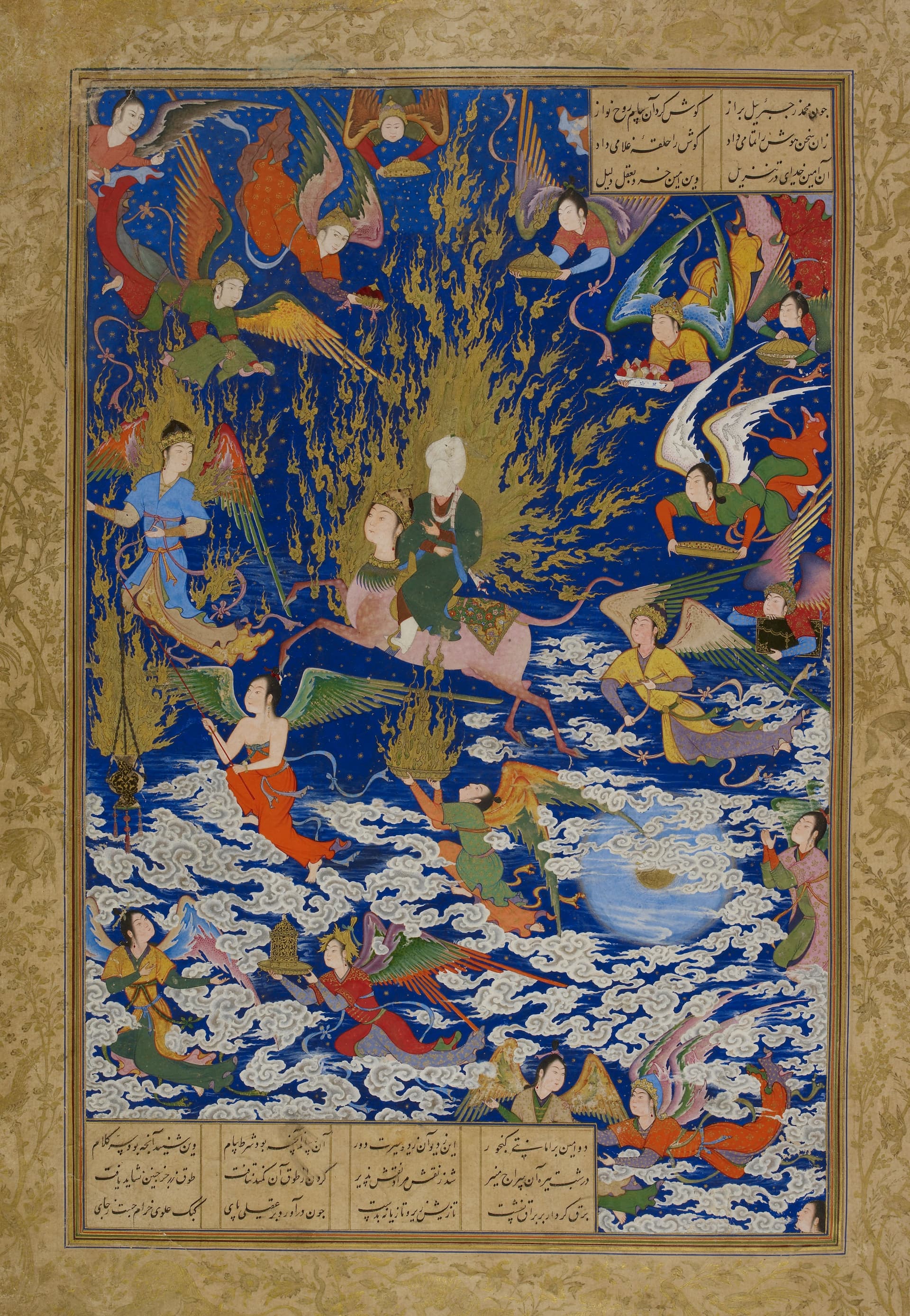
by Sultan Mohammed
Read BiographyYear
between 1539 and 1543
Medium
gouache, gold and ink on paper
Dimensions
28.7 cm x 18.6 cm
Region
Iran
Listen
click play to listen
The Ascent of Muhammad to Heaven (Mi'rāj) (1539–1543, opaque watercolour, ink, and gold on paper, 28.7 × 18.6 cm, British Library, Or. MS 2265, fol. 195r) is a miniature painting attributed to Sultan Muhammad, the greatest painter of the Safavid court at Tabriz, Iran, produced as an illustration to the Khamsa ("Five Poems") of Nizami Ganjavi in the luxury manuscript commissioned by Shah Tahmasp I. It depicts the Prophet Muhammad's miraculous night ascent through the heavens on the back of the celestial steed Burāq, guided by the archangel Gabriel and escorted by nineteen angels. The Prophet's figure is enveloped in golden fire — the visual representation of the nūr muhammadī, the primordial light of Muhammad in Islamic mystical theology — which simultaneously manifests his divine essence and conceals his face in honor of the tradition of aniconism. The painting synthesizes the Tabriz school's Dionysiac visual energy with the Herat school's compositional discipline, deploys Chinese-derived cloud forms in its celestial space, and achieves a density of visual incident and a quality of material splendor that have led scholars to identify it as the apex of Islamic religious art. Sultan Muhammad — who was simultaneously Shah Tahmasp's painting teacher and his court's most gifted miniaturist, and who himself wrote about the theological complexity of representing living beings in art — produced in this painting the definitive visual statement of the most theologically charged moment in Islamic sacred history.