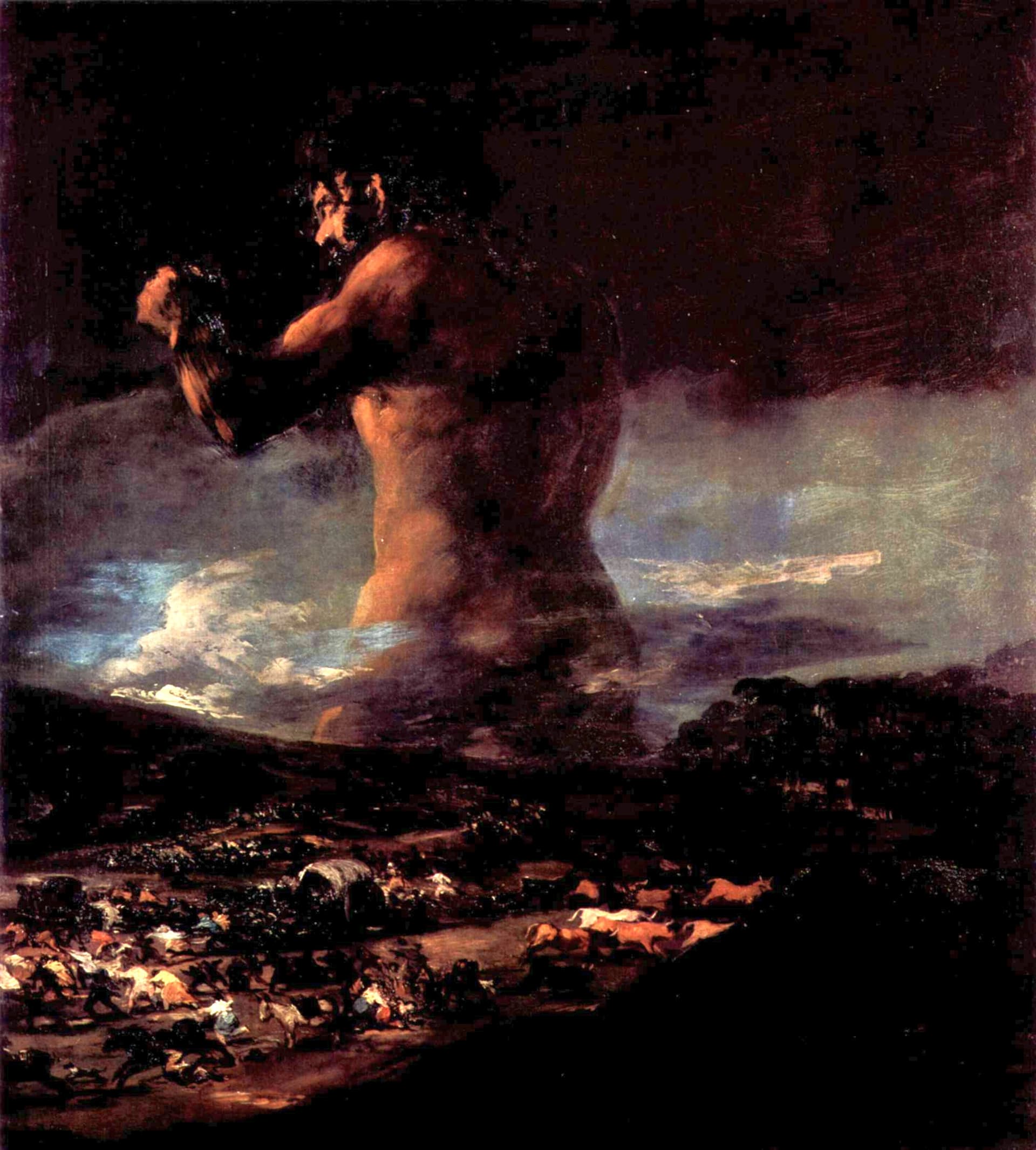
by Francisco Goya
Read BiographyYear
Circa 1808–1812
Medium
oil on canvas
Dimensions
116 cm × 105 cm
Region
Spain
Listen
click play to listen
The Colossus (El Coloso, c. 1808–1812, oil on canvas, 116 × 105 cm, Museo Nacional del Prado, Madrid) depicts a monumental nude male figure striding across a mountainous landscape, his lower body obscured by the mountains he dwarfs, while a terrified multitude of people and cattle flee in all directions in the valley beneath him. Traditionally attributed to Francisco de Goya and dated to the Peninsular War period (1808–1814), the painting entered the Prado collection in 1931 through the bequest of Pedro Fernández Durán and had been considered one of Goya's most powerful and prophetically modern allegorical paintings until 2008, when the Prado's chief curator Manuela Mena announced technical evidence — including apparent initials "A.J." revealed by X-ray, a pattern of hesitation and revision untypical of Goya's working method, and differences in the black pigment — suggesting the work was instead by Goya's Valencian assistant Asensio Juliá. The attribution debate that followed engaged leading Goya scholars on both sides of the question, generating a significant body of scholarly literature. In 2021, the Prado quietly restored Goya's name to the work's label as "attributed to Goya" — stopping short of a definitive attribution while acknowledging that the case against Goya was insufficient to maintain the Juliá attribution with confidence. The painting's imagery is most plausibly linked to Juan Bautista Arriaza's patriotic poem Profecía del Pirineo (1810), whose verbal image of a pale Colossus rising above the Pyrenees with ruddy clouds encircling his waist corresponds precisely to the painting's composition. Regardless of its final attribution, The Colossus remains one of the most powerful and most discussed paintings in the Prado's collection — an image of overwhelming historical force whose meaning continues to generate new interpretations more than two centuries after its making.