Year
1830
Medium
Color woodblock print (nishiki-e); chuban
Dimensions
25.3 cm × 18 cm
Region
Japan
Listen
click play to listen
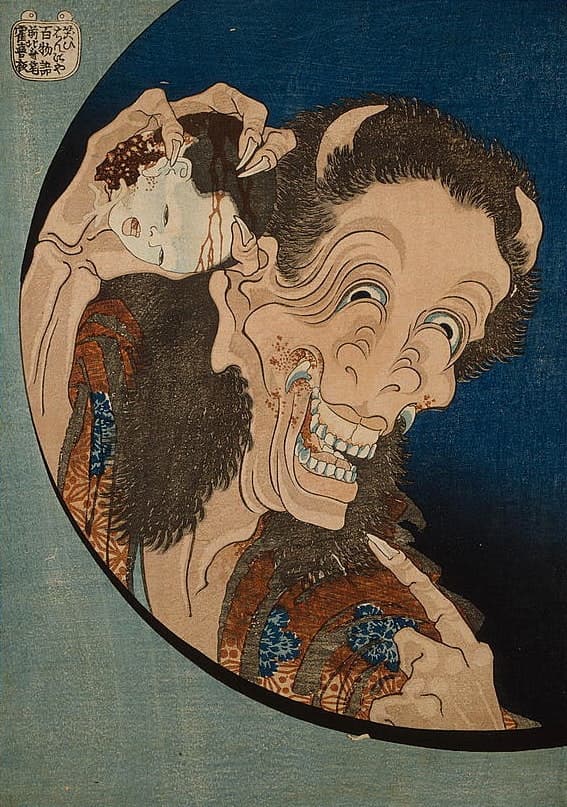
The Laughing Demon (Warai Hannya, 1831–1832) is a color woodblock print in the chuban format, produced by Katsushika Hokusai for the projected series Hyaku Monogatari ("One Hundred Ghost Tales"), published by Tsuruya Kiemon. It is one of only five prints completed from what was intended to be a series of one hundred, each corresponding to a ghost story from the ritual Hyakumonogatari Kaidankai — the gathering in which samurai told ghost stories one by one while extinguishing candles, progressively darkening the room until the supernatural world grew dangerously close. Produced simultaneously with The Great Wave off Kanagawa and utilizing the same newly affordable Prussian blue pigment that Hokusai's contemporary audience associated specifically with death and the occult, the print depicts a composite folkloric demon — a synthesis of the hannya (a woman transformed into a demon by jealousy) and the yamauba (an infanticidal mountain ogress) — laughing in triumph as she holds the severed, blood-dripping head of an infant. The image carries a Buddhist subtext through its connection to the legend of Kishimojin/Hariti, an infant-devouring ogress who underwent complete spiritual transformation through the Buddha's intervention and was eventually venerated as a protector of children. Produced by a man in his early seventies at the summit of his creative powers, the Laughing Demon is simultaneously a masterwork of formal design, a culturally specific document of Edo-period supernatural belief, and a foundational image in the long history of Japanese horror aesthetics.