Year
circa 1771
Medium
oil on canvas
Dimensions
23 cm × 12 cm
Region
Italy
Listen
click play to listen
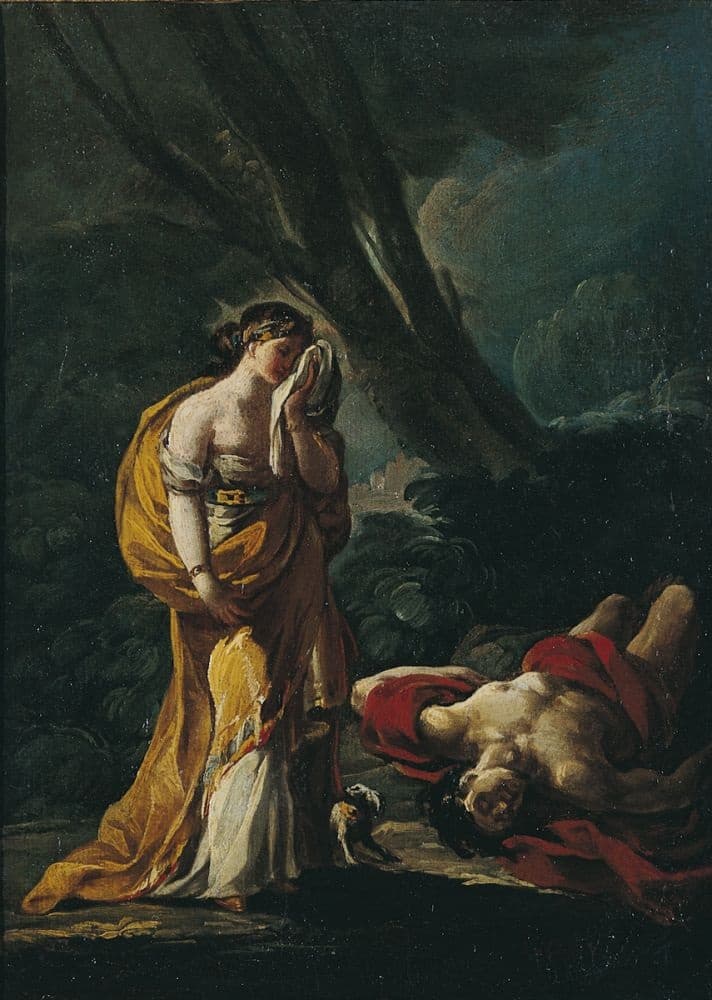
Venus y Adonis (Venus y Adonis, c. 1771, oil on canvas, 23 × 12 cm, Museo de Zaragoza) is a small mythological cabinet picture by Francisco Goya, produced during his self-funded sojourn in Italy between 1769 and 1771 as one of several small paintings adapted to the tastes of specific clients and sold quickly to cover his living costs. The painting depicts the moment from Ovid's Metamorphoses when Venus discovers the body of Adonis, killed by a wild boar, and weeps inconsolably at his side — a choice of the post mortem lamentation moment that aligns the mythological subject with the tradition of funerary mourning imagery from the Christian Pietà to the secular lament. The composition is divided diagonally by the trunk of a tree, creating a dramatic contrast between the dark Baroque background of tempestuous sky and forest and the brightly illuminated foreground figures. Adonis's anatomy reflects Goya's direct study of classical sculpture in Rome, documented in his Italian Notebook now held by the Museo del Prado. The painting's X-ray shows no revisions, confirming its rapid, confident execution. Inspired by Corrado Giaquinto's 1732 treatment of the same subject at the Villa della Regina in Turin, and working within the broader tradition of Titian, Rubens, and Poussin, Goya produced a work that demonstrates his complete fluency in the European mythological painting tradition at the precise moment of his most intensive engagement with that tradition. After passing through private collections in Bayonne, Zurich, and North America, the painting was acquired by the Government of Aragón in 1999 and entrusted to the Museo de Zaragoza — returned to the region of Goya's birth, where it documents the formative Italian journey of one of the greatest painters in Western art history.