Listen
click play to listen
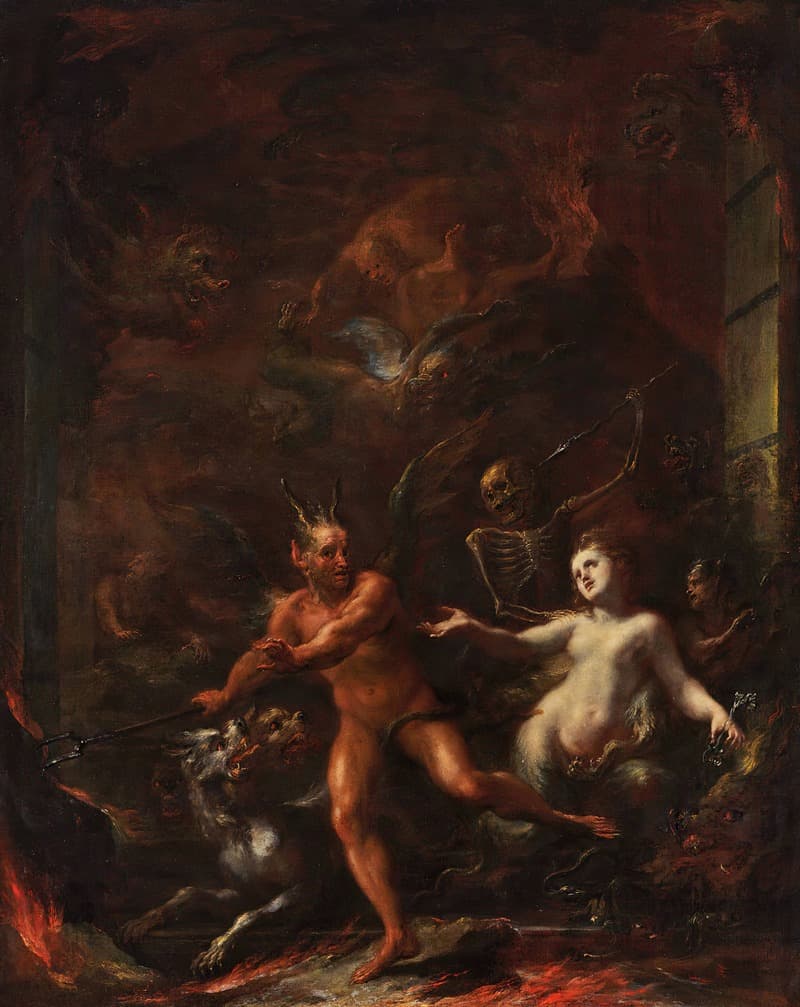
Gates of Hell, ca. 1703–08, by Giacomo del Po (Italian, 1652–1726), oil on canvas, 126 × 101 cm, Gift of Eula M. Ganz in memory of her husband, Paul H. Ganz. The painting illustrates the climactic episode of Book II of Milton's Paradise Lost (1667), in which Satan — having persuaded his demonic council to allow him to seek out and corrupt God's newly created world — journeys to the gate of Hell and encounters its two monstrous guardians: his daughter Sin (beautiful from the waist up, serpentine below, with hellhounds perpetually barking in her womb) and his grandson Death (a formless dark shape of terrible power, crowned with the simulacrum of royalty). The three figures — bound by relationships simultaneously familial, sexual, and ontological — are at the point of violent confrontation when Sin intervenes; she then uses her key to open the gates, which cannot thereafter be closed, releasing Satan into the Chaos between Hell and the newly created cosmos. Produced in the mature period of del Pò's career (c. 1703–1708), probably commissioned for a Neapolitan noble patron, and related to a preparatory drawing at the Fine Arts Museums of San Francisco, the painting is the only signed work in del Pò's oeuvre and the most significant surviving oil painting by the artist. Identified as a Milton illustration by the scholar Walter Vitzthum in 1970 and documented in the subsequent scholarship of Donald Rabiner and Dwight C. Miller, it entered the Princeton University Art Museum in 1986 through the bequest of Eula M. Ganz in memory of her husband Paul H. Ganz. It stands as the earliest known major oil painting of the Satan-Sin-Death episode in the history of Milton illustration — predating Blake, Hogarth, and Fuseli by half a century — and as a remarkable testimony to the international cultural reach of Paradise Lost through early eighteenth-century European artistic culture.