Year
1888
Medium
oil on canvas
Dimensions
72 cm x 91.5 cm
Region
France
Listen
click play to listen
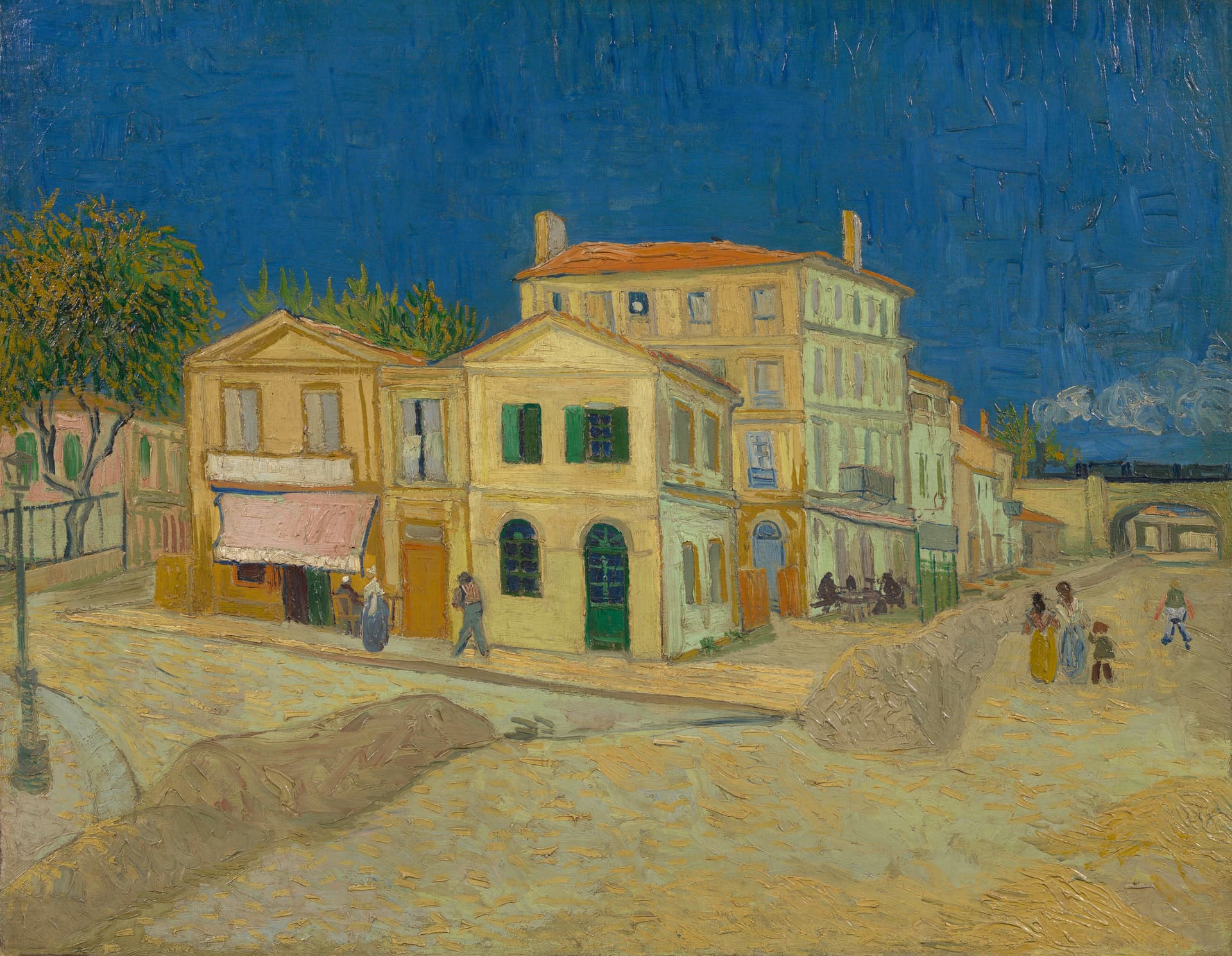
The Yellow House (September 1888, oil on canvas, 72 × 91.5 cm, Van Gogh Museum, Amsterdam) is a Post-Impressionist cityscape by Vincent van Gogh, depicting the right wing of 2 Place Lamartine, Arles — the building he rented from May 1888 until his breakdown in December of that year, which he called his "Studio of the South" and hoped to make the center of a utopian community of progressive painters. Van Gogh himself titled the work The Street. Painted in late September 1888, at the moment of his first genuine inhabitation of the building and in the weeks immediately before Paul Gauguin's arrival, the painting organizes its Provençal street scene around a dominant chromatic opposition of chrome yellow and cobalt blue — the most extreme complementary color contrast available to Van Gogh's palette and the chromatic signature of his entire Arles period. The building's specific architectural features — the green-shuttered guest room and bedroom windows on the first floor, the pink restaurant building to the left, the railway bridges in the background — are documented with biographical precision in Van Gogh's letters to Theo. The actual Yellow House was severely damaged by an Allied bomb on 25 June 1944 and subsequently demolished, making the painting the sole surviving visual record of its appearance. Remaining in the Van Gogh family until 1962, the painting passed to the Vincent van Gogh Foundation and thence to the Van Gogh Museum in Amsterdam, where it is now permanently displayed as one of the central biographical and artistic documents of Van Gogh's most creative and most catastrophic year.